![]() | ||||
|
||||
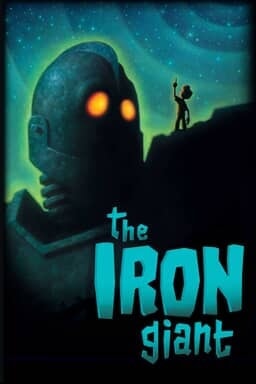
![]() ![]() In October of 1957, America had plenty to be worried about. Rock n roll. Television. The bomb. And on the fourth day of that month, the Soviets successfully launched the first manmade satellite, Sputnik, into orbit. The space race had officially begun. The Cold War just got colder. People were unsure about their neighbors, even questioning their friends.
So when a local fisherman comes into the diner with a tall tale about a huge metal man falling into the sea, the only one to pay him much attention is Hogarth, who sets out exploring to find the enormous robot. What he does find is a 50-foot giant with an insatiable appetite for metal and a childlike curiosity about its new world.
But it isnt long before the rumors turn into paranoiathe situation escalates and the possible destruction of Rockwell looms. Hogarth turns to his friend, the Iron Giant, who ultimately finds its humanity by unselfishly saving the towns residents from their own fears and prejudices. In times like these, you really find out what your friends are made of sometimes, even metal. Acclaimed animation director and writer BRAD BIRD was given a unique opportunitythe full backing of a major studio while maintaining the creative autonomy and independent spirit that has allowed him to create the groundbreaking animated projects that has cemented his reputation as an animation auteur. He comments, "Warner Bros. gave us the strongest support to create The Iron Giant and allowed us an unbelievable amount of creative freedom to put our ideas up on the screen."
About the Production. . . In 1968, a childrens book by British Poet Laureate Ted Hughes (1930-1998) was publishedits title in the U.K. was The Iron Man and, in the United States, The Iron Giant. The story of a huge robot and its friendship with a young boy grew out of a story told by Hughes to comfort his and American poet Slyvia Plaths (1932-1963) two children following their mothers death.
Prolific theatrical producer/director Des McAnuff, who had adapted the Tony Award-winning "The Whos Tommy" with Townshend for the stage, believed that "The Iron Man" could translate to the screen, and the project was ultimately acquired by Warner Bros. Towards the end of 1996, while "The Iron Man" project was working its way through development, Brad Bird was developing a feature for Turner during the period when Turner had been merged with Warner Bros. The noted animation writer and director had worked on such groundbreaking television projects as "The Simpsons," "The Critic" and "King of the Hill" and the had rightfully earned the reputation as an up-and-coming force in the resurgence of the popularity of animation. (Bird had also written, directed and co-produced the acclaimed "Family Dog" that aired on Steven Spielbergs weekly television anthology series, "Amazing Stories.")
Birds version of Hughes tale kept the central characters of the story, but surrounding the relationship between Hogarth and the Giant, the director put a distinctly American spin on the 30-year-old British childrens book. He explains, "Hughes book is a great story that tries to show kids about the cycle of lifeeven though there is death, life has a continuity. My version is based around a question I asked the execs at Warner Bros.what if a gun had a soul and chose not to be a gun? Basically I wanted to honor the book, but also take it in a new direction." Screenwriter Tim McCanlies worked with Bird to realize the script. Bird comments, "Tim and I had a wonderful experience collaborating on The Iron Giant. I first fell in love with Tims work when I read his screenplay Second Hand Lions. I knew then that he was the perfect writer to help bring The Iron Giant to the screen. Tims writing has a sweetness and an innocence to it which speak to the very core of our film." Later during production, the filmmakers sent Ted Hughes a copy of "The Iron Giant" script. The author sent a letter back, saying how pleased he was with Birds version. In the letter, Hughes rather poetically stated, "I want to tell you how much I like what Brad Bird has done. Hes made something all of a piece, with terrific sinister gathering momentum and the ending came to me as a glorious piece of amazement. Hes made a terrific dramatic situation out of the way hes developed The Iron Giant. I cant stop thinking about it "
The shift in setting was carefully considered by Bird. He continues, "The 50s are a wonderful time in which to set this movie. America was at a crossroads. We were learning to live with the atom bomb; the space race was just beginning; paranoia was at a high; and all of this got into the movies of the time giant ants and mutated Martian men. Thats a pretty funny response to all of those influences. So if youre going to have a story about a human boy who befriends a metal man, its fitting to put it into the context of the fear that existed at that time.
Key to the filmmakers retelling of The Iron Man is the giants fundamental purposewhatever its origin, it was undoubtedly created as a weapon a gun with a soul. "In our version of the story, the boy is basically the parent and the giant is the child. I think that each one of us has both the potential for great good and for horrible destruction. Every day, in big and small ways, we are choosing which side of us we are going to act on. Hogarth helps this machinethat is built for another purposeto find a different side of itself, and it becomes somewhat human in the process," the director concludes. Birds pitch to Warner Bros. was in late 1996. A deal was made, and work bgan on "The Iron Giant" on January 2, 1997. Building a Better Giant
Abbate remembers, "Once we were given the green light to begin pre-production, Tim McCanlies and Brad started writing the script and working simultaneously with the story board artists. We began with just a treatment and Brad would bat ideas back and forth with the story board artistsit was an amazingly dynamic time, and it really allowed all of us to get into Brads head. We hammered away at it and by August, we had about 30 minutes of the film story boarded and we were given our green light to go into production."
From these early sketches, characters began to emerge. Head of animation Tony Fucile was in charge of assembling the team of animators who created the characters and their world. He explains, "Once design begins on the characters and the look of each is approved, we wind up with something called model sheets, which function as blue prints for the character. Basically, character designs are taken and then rotated in space so animators can figure out how to draw them from all angles. We experiment with various emotions, facial expressions and body positions. This gives the animator more freedom, because he has studied what shapes are underneath the skull, how the ears are attached, that sort of thing."
"Everyone is trying, especially at the beginning, to figure out how do I draw these characters? We have about 50 animators and 75 or so clean up artists [who literally clean up the animators drawings], so well have about 125 people working on the same character. We didnt want Hogarth to suddenly turn into somebody else," comments Fucile. A Rock and a Hard Place
Filmmakers took great care, however, to bring the giant into Hogarths world, not wanting the character to appear so foreign that it would not mesh into the scenes in and around Rockwell, Maine in 1957. Bird explains, "I gave the crew sort of an edictimagine that this is 1940 during the golden age of animation. How would you draw something like this by hand? So we simplified the characters shapes and also analyzed the qualities of hand-drawn animation versus computer animation, ultimately looking for ways to meld the two." Animators knew that computer-generated lines are exact and lines rendered by hand are imperfect. ("We took months to create a computer program that actually wobbles the lines of the giant a bitjust enough so that it feels hand-drawn," adds Bird.) Existing special software was also extended and modified to accomplish a myriad of thingsaiding in shading of the giant, varying the lightening and darkening of some frames and altering grain patternsto affect the giants realistic inclusion in his strange new (and classically animated) world.
"But there is also an innocence to the giant," counters Abbate. "His design is very simple and clean. We wanted him to appear almost like a baby at the beginning of the film. Hes a little bit like all of uswe all start out not knowing who we are, where we come from or why were here and we all have to choose our life path." Someone else who contributed to the realization of the giant was artistic coordinator Scott Johnston, who drew on his extensive experience in computer graphics to help Bird and his staff of artistic supervisors solve the problems inherent in mixing classic animation with CGI. "We wanted the giant to be an alien presence," offers Johnston. "We also wanted to keep the rigidity of his form, yet allow him to be able to express a wide range of emotions. He has a simple jaw shape that cant really bend into a smile or a frown, but he has other ways of expressing thoughts and ideas through physical movements."
Filmmakers also looked to period artists, such as Norman Rockwell, Edward Hopper and N.C. Wyeth, for their style and use of color. Period magazines, graphics and films were additional inspirations for the look of the film. The decision was also made to shoot the film in "wide screen," a format popularized in the 1950s. The Giant Talks
He says, "I am not a huge fan of designing characters to have the look of the celebrity voicing it. I feel thats a very limited way of thinking. I prefer to approach the whole issue by asking, Who is the character and how does that character look? Then I find a voice to suit the character. I mean, Homer Simpson looks nothing like Dan Castellaneta, who voices him. I like to find a voice that compliments the design of the character." Bird continues, "I look for actors with distinctive voices. In live-action films, actors can use their whole bodies to convey who they are. The challenge here is to make sure all of the nuances of character can come through with just the voice. That serves the animation as well. It you want the best out of your artists, you want to give them a soundtrack thats inspiring. You also dont want to hamstring the animators into any kind of visual actingyou want them to invent stuff to go with the voice. So the voice should inspire the animator, and the better the voice, the better the animation."
"The thing I liked about Annie and this project," observes Aniston, "is that its not at all whats expected. Shes more like a mom from the 70s than the 50s. Shes very strong, like a mother tiger protecting her son, Hogarth. Shes funny and really spunky, in that great kind of Laura Petrie way. Theres also a tremendous heart to the story. Im really happy to have been involved in the film."
"I had an idea immediately who Dean was," says Connick. "I grew up in the South surrounded by guys who see the world in different way. Artists, jazz musicians, crazy guys in New Orleans. I had a blast working on this project." For Hogarth, Bird wanted a fresh young voice with a quality different from most child actors. "Hogarth needed to be innocent, but tough enough to be on his own most of the time. Hogarth has lost his father, plus hes too smart for the kids his own age, so hes developed a great imaginary world of his own making. Hes always on the lookout for nuclear monsters or invaders from outer space, but hes also constantly rescuing animals who need a home."
(Scott Johnston also comments on Hogarths powerful imagination and enthusiasm for life. He says, "When I look at Hogarth, I can get a sense of what Brad must have been like as a kid.")
"I play Kent, and hes pretty full of himself. He wants to break out of the bowels of Capitol Hill, where he has this little windowless office," elaborates McDonald. "I had done animation before, doing the voice of Jor-El for the series of Superman. Your imagination takes over and the possibilities are limitless. But its also very challenging because its only the voice that comes through. In a way, its a little like Shakespeare, because the words are key."
Diesel felt a kinship with the giant, saying, "The Iron Giant is misunderstood. His strength is the bane of his existence and despite the fact that hes designed as a killing machine, he is really as simple as a child. Ive always said that I feel like a bull in a china shop, and with the giant, he moves to scratch his back and buildings fall. Actually, I think we came from the same planet. "Im an animated actor, so to speak," continues Diesel. "I use my body, my hands, my expressions. And in doing this kind of work, all of that is irrelevant, all of that is erased. The voiceit was a luxury to just get behind the microphone and go to work."
Young at Heart As a means of paying homage to the generations of animators who inspired Bird and assisted him in his career, the filmmakers enlisted the help of two classic animation veteransVictor Haboush and Ray Aragon. Producer Abbate says, "Victor and Ray really helped us in the early stages of visual development, especially when we visited Maine and began to adopt the style of our story. They were an inspiration. In some ways, Victor and Ray also helped us bring Dean to lifeboth were these incredibly creative guys who were artists and cool cats in the 50s." The director was also intent on actively involving current students at Cal Arts on the film. While staffing, Bird saved spots for several students to work as rough in-between artists (who take animators key character poses and execute all drawings in between to complete action on segments of the film). Bird hired four animators who had worked together on an animated short at school. Later, impressed with the groups skills, the director offered to let the four animate an entire sequence of "The Iron Giant"fittingly, a scene in a classroom.
Allison Abbate comments, "Everyone was really motivated to keep to our tight schedule. I actually think that not having an extended period of development helped us in a way. There is less wasted time because the artists have an investment in their sequences and they work together to solve problems immediately as they arise. Having Brad at the helm kept us all very clear about the vision. It was exhausting and it was great." (Actor Diesel notes, "Brad directs like a conductor. He literally gets all of the notes by waving his hand.") One of the advantages of animation over live-action is, as Abbate points out, "getting to see your movie long before its going to be finished." Periodically throughout production, the filmmakers assembled the film and looked at it, analyzing everything from story points to character continuity. The film, like any artists vision, went through periods of change and growth; some segments were extended, others, eliminated.
Warner Bros. Presents "The Iron Giant," starring the voices of Jennifer Aniston, Harry Connick, Jr., Vin Diesel, James Gammon, Cloris Leachman, Christopher McDonald, John Mahoney, Eli Marienthal and M. Emmet Walsh. The music is by Michael Kamen. It is executive produced by Pete Townshend. The screen story is by Brad Bird and the screenplay is by Tim McCanlies, based on the book, The Iron Man, by Ted Hughes. The film is produced by Allison Abbate and Des McAnuff. "The Iron Giant" is directed by Brad Bird. It is distributed by Warner Bros., A Time Warner Entertainment Company. Copyright © 1999 Warner Bros. (All rights reserved). This written material to be used solely for advertising, promotion, publicity or reviews of this specific motion picture and to remain the property of the studio. |